
Bill Hancock was the College Football Playoff’s first executive director. When he was hired in 2012, he was its only employee. He built the thing from scratch and ran it until he retired in 2025.
In 2018, Hancock walked reporters through how the committee works. According to The Dallas Morning News, he said the committee would probably need “overwhelming evidence” to overturn a head-to-head result between comparable teams.
Overwhelming evidence. Hold onto that.
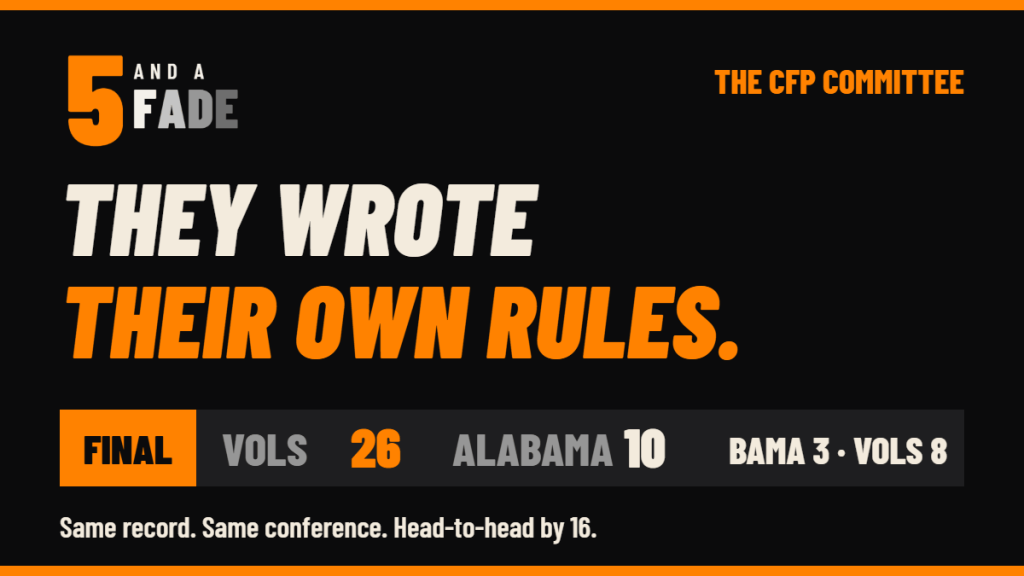
Alabama is 7-2. Tennessee is 7-2. Tennessee beat Alabama 26-10. Not on a fluke. Not on a last-second field goal. By 16.
The committee has Alabama third. Tennessee eighth. Make it make sense.
The pod
The man who’s supposed to explain this is the committee chair, Arkansas athletic director Hunter Yurachek. After the first rankings, he went on ESPN and said, “To compare teams head to head, they have to be in the same pod.”
The same pod.
They ranked the two teams eight spots apart, then said they’re too far apart to compare. They built the wall and then pointed at it. A week later, we’re still five spots behind the team we beat.
They wrote their own rules
The committee wrote its own rules. They’re on its website. When teams are comparable, it weighs strength of schedule, head-to-head, results against common opponents and “other relevant factors.”
Other relevant factors. Decided by whom? The rules don’t say. So that last bullet lets them make up whatever criteria they want. Then they gave themselves a secret ballot, so nobody’s name is attached to a single vote.
That’s unfettered discretion with nobody watching. They act like they’re following a rulebook. They don’t have to.
Compare that to the SEC. When two SEC teams finish with the same conference record, the first tiebreaker is head-to-head. Everybody knows it before the season starts. That’s what real rules look like.
“Four really good wins”
This week, Hunter said “Alabama has four really good wins in the view of the committee.” One is at LSU. That takes care of itself a week from Saturday, when LSU comes to Knoxville.
Another is at Mississippi State, which is 4-5 and has lost five straight. The committee’s excuse is that State was undefeated at the time.
Oh, my bad. So they were really good right up until they lost five straight. My mistake.
Fine. Then grade everything at the time. Alabama was No. 6 when we beat them by 16. Texas was No. 1 when it beat us by three. Kentucky, another of Hunter’s four, was unranked when Alabama beat them in September. They were the committee’s No. 6 when we beat them by 28. When Alabama got South Carolina, the Gamecocks were coming off a home loss to that same Mississippi State. When we got them, they’d just won in the Swamp and were coming off a bye. We handed them that game in the last four minutes, and they haven’t lost since.
You can’t have it both ways.
Comparable is a low bar
The whole rulebook hangs on one word: comparable. The committee never defines it, so I looked it up. Merriam-Webster says it means “capable of or suitable for comparison.” Or simply, “similar, like.”
Not identical. Not indistinguishable. Two 7-2 teams with two SEC losses each clear that bar without breaking a sweat. If two teams that played each other can’t be compared, nobody can.
Now they want to talk strength of schedule. Sure, it’s on the list. But so is head-to-head, and only one of those was decided by the two teams playing each other. A “tougher” schedule doesn’t make two teams with the same record not comparable.
Who’s in the room
Thirteen people. Six are sitting athletic directors at Nebraska, Utah, Virginia, Arkansas, App State and Middle Tennessee, with full-time jobs. Then four retired coaches, two former players and a retired sportswriter.
Nobody elected them, nobody sees their votes, and their own rulebook lets them count anything they want. That’s not a selection committee. That’s Tom, Dick and Harry with a remote and a secret ballot.
Show us the evidence
Hunter, show us the overwhelming evidence. A win at a 4-5 Mississippi State? A home win over a South Carolina team we lost to by three on the road? That’s not overwhelming evidence that the teams aren’t comparable. That’s a shrug.
Next year, it gets worse
Starting next season, the Playoff goes to 24 teams. Five spots are automatic. The committee picks the other 19. This year, it picks seven.
Same process. Same secret ballot. Same “other relevant factors.” Nearly three times as many teams to hand out. If they can’t get Tennessee and Alabama right with a head-to-head result sitting in front of them, what happens when they’re picking teams 20 through 24?
Bottom line
It bears repeating: same record, same conference, same number of conference losses, and we beat them by 16. By any dictionary, that’s comparable, and by the oldest rule in sports, the team that wins goes ahead. Thirteen people wrote their own rules and gave themselves a secret ballot, and they still can’t follow that one. So beat A&M, beat LSU, beat Vanderbilt, and make them explain it.
The Correct Top 10 follows that rule every week. Share this with somebody who still trusts the committee.
Jeremy Durham is a sports columnist for TriStar Daily and the founder of Five and a Fade. He writes a weekly Tennessee Vols preview and the Five and a Fade picks column. All of Jeremy’s columns · jeremyrdurham.com · Newsletter · X · Instagram

