This is Part 2. Read Part 1 here.
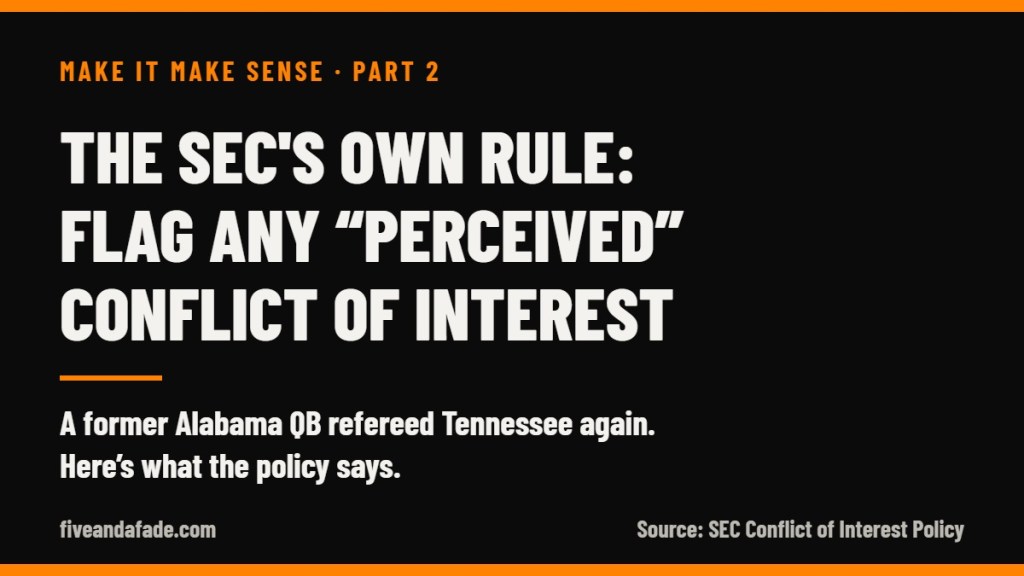
Yesterday I asked why a former Alabama quarterback refereed Tennessee’s 27-24 loss at South Carolina, one week after Tennessee beat Alabama 26-10. A lot of you had thoughts. So I went and read the SEC’s own rule on it. Here it is, word for word, so you can judge for yourself.
What the SEC’s rule says
The SEC posts its conflict-of-interest policy for officials on its website. It covers football and men’s and women’s basketball. Here’s the full text:
An individual will not be assigned as an official for a game involving:
- A university from which the official graduated or was enrolled;
- A university where immediate family (spouse or children) is currently enrolled;
- A team with a head coach for whom the official played;
- A university with an immediate member of the official’s family (e.g., parent, spouse, child) serving as a member of the team’s athletics department staff;
- A circumstance when the official has a business relationship with a university (i.e., vendor, donor, sponsor, client or employee); and
- A university with an immediate member of the official’s family (e.g., parent, spouse, child) serving as an employee at the university;
Each official is expected to identify any other circumstances that may create a potential, perceived or actual conflict of interest for the official. The commissioner reserves the right to determine whether the circumstances merit removal of the official from an assignment or assignments.
SEC Conflict of Interest Policy (football, men’s basketball, women’s basketball), posted on SECsports.com
You can read it yourself on the SEC’s site: SEC Conflict of Interest Policy.
What the rule doesn’t say
There’s nothing in there about your old school’s rivals. David Smith played quarterback at Alabama from 1985 to 1988. By the letter of the rule, he can’t work an Alabama game. Tennessee, Auburn, LSU? All fair game.
But read that last paragraph again. The SEC itself set the standard: any conflict that’s “potential, perceived or actual.” It doesn’t say “proven.” It says perceived.
And it’s not the first time
According to Rocky Top Insider, Smith was also the referee for the 2022 Tennessee–South Carolina game, the upset that knocked Tennessee out of the playoff picture, and for Tennessee at Mississippi State in September 2025. Saturday in Columbia makes at least three Tennessee games since 2022.
My take
I’m not saying anybody cheated. People who follow officiating say he’s a good ref. But integrity is the whole product, and the SEC wrote this rule to protect it.
A former Alabama quarterback refereeing Tennessee the week after Tennessee beat Alabama is about as clear a “perceived” conflict as you’ll find. Either he should have raised his hand, or Birmingham should have. The policy even says the commissioner can pull an official off a game.
The fix is easy: add your alma mater’s biggest rivals to the list. Nobody would argue with that. Not even Alabama fans.
Watch Part 1
What do you think, Faders? Should the SEC add rivals to the rule? Tell us on X at @fiveandafade.
Every pick is free. Get them by email: subscribe here.
Jeremy Durham is a sports columnist for TriStar Daily and the founder of Five and a Fade.

